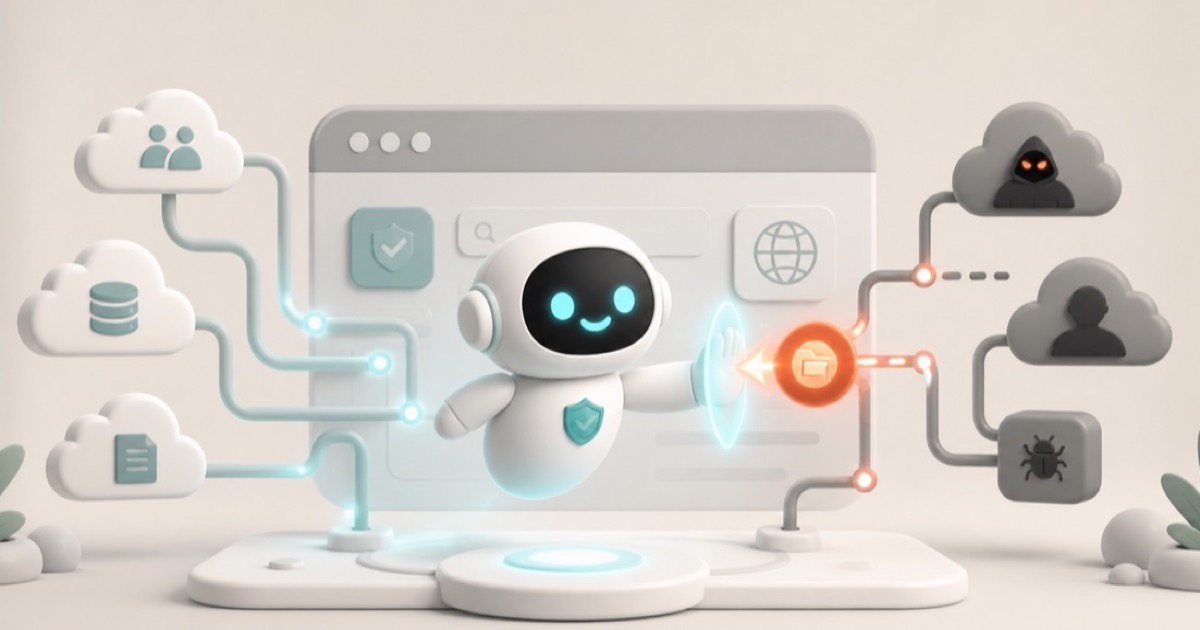
What Is Shadow AI? A Complete Guide
- Shadow AI is any AI tool, agent, MCP server, extension, or skill that employees and developers adopt and use without security review, approval, or visibility.
- It emerged bottom-up on the endpoint because capable AI arrived as a free download or a browser tab, not as a procured enterprise system, so it bypassed the usual intake controls.
- Shadow AI is a sharper version of classic shadow IT because the tools act autonomously, hold real credentials, read untrusted content, and can take destructive actions rather than just storing data.
- The main risk categories are unvetted third-party code, over-privileged access, sensitive data exposure, and a missing audit trail across every AI artifact on the endpoint.
- You cannot block your way out of it, so the working approach is discover, then govern: inventory every AI artifact, map what each one can reach, then apply policy where the artifact runs.
- You can't govern what you can't see, which is why continuous endpoint discovery is the prerequisite for any shadow-AI program to hold.
Shadow AI is any AI tool, agent, MCP server, extension, or skill that people inside an organization adopt and use without security review, approval, or visibility. It is the AI-era descendant of shadow IT, and it has grown faster than almost any technology risk before it, because the most capable AI now arrives as a free download or a browser tab rather than as a procured enterprise system. A developer installs a coding agent on Monday, wires up an MCP server on Tuesday, and shares a skill with the team on Wednesday, all with real credentials and real system access, and none of it ever crosses a security desk. This guide defines shadow AI precisely, explains why it emerged, walks the risk categories, and lays out the discover-then-govern approach that actually works.
A working definition of shadow AI
The word covers more ground than most people assume. Shadow AI is not just employees pasting text into a public chatbot, though that is part of it. It is the whole population of AI artifacts running on your endpoints that no one sanctioned or sees: autonomous agents that plan and act, Model Context Protocol (MCP) servers that expose tools and data to those agents, browser and IDE extensions that add AI behavior, plugins, reusable skills, the secrets those artifacts carry, the hooks they trigger, and the command-line tools that drive them. Anomity groups these into eight AI artifact types precisely because governing shadow AI means seeing all of them, not just the chatbot tab. Local model runtimes are part of that population, and an important one: as Anthropic's GLM-5.3 study showed, a downloaded model carries none of the safeguards hosted frontier models ship with.
The defining property is not the technology but the absence of oversight. A sanctioned, reviewed, monitored AI agent is not shadow AI. The same agent, installed by a developer who found it useful and never told anyone, is. Shadow AI is defined by the gap between what is running and what security knows is running.
Why shadow AI emerged: adoption moved to the endpoint
Enterprise software used to arrive through a front door. Someone requested it, procurement negotiated it, security reviewed it, IT deployed it, and only then did it touch company data. That intake process was slow, but it was a control point. Shadow AI happened because the most capable AI tools skipped the front door entirely and shipped straight to the individual.
The adoption is bottom-up and it lives on the endpoint. A single engineer can install an agent, connect an MCP server, and grant it access to source code and cloud credentials in an afternoon, entirely within their own machine and accounts. There is no purchase order, no vendor review, no network appliance in the path. The productivity gains are immediate and genuine, which is what makes the pattern unstoppable by policy alone: telling people not to use tools that make them measurably faster simply moves the usage somewhere you cannot see it. This is the same dynamic, sharpened, that we describe in our pillar on how AI agents are the new shadow IT.
How shadow AI differs from classic shadow IT
Shadow IT and shadow AI share a root cause - unsanctioned adoption outrunning oversight - but the risk profile is different in kind, not just degree. Classic shadow IT was largely about data at rest in the wrong place: an unapproved SaaS app, a personal cloud drive, a spreadsheet emailed to a home account. The harm was mostly exposure and compliance drift. Shadow AI is active and agentic. The artifact does not just store data; it holds credentials, reads untrusted content it did not author, makes autonomous decisions, and takes actions with real consequences.
- It acts, it does not just store. An agent can run shell commands, call internal APIs, modify files, and spend money. Shadow IT rarely did anything on its own.
- It carries real identity. Agents and MCP servers hold API keys, OAuth tokens, and cloud credentials, so a compromised artifact is a compromised identity, not just leaked data.
- It reads untrusted input mid-task. Because agents consume web pages, documents, and tool output, an attacker can steer them through content they never controlled - a risk class that has no clean shadow-IT analog.
- It spreads through code, not accounts. A single shared skill or config can propagate a capability, or a payload, across an entire team in days.
- It is harder to see. A rogue SaaS app shows up in expense reports or network logs. An agent, an MCP server, or a skill lives inside a developer's process on the endpoint, invisible to network and identity tooling.
The risk categories of shadow AI
Every specific shadow-AI incident traces back to one of a small number of categories. The table below is the map: the risk, why it stays invisible, and the control that addresses it. The rest of this section walks each one.
| Shadow AI risk | Why it is hard to see | Control |
|---|---|---|
| Unvetted third-party code (agents, MCP servers, skills) | Installed on the endpoint by individuals, never reviewed, invisible to network and procurement tooling | Continuous endpoint discovery plus a vetting step before install |
| Over-privileged access | Agents inherit broad standing credentials from existing service accounts that no one audits | Per-agent identity, scoped short-lived credentials, least privilege |
| Sensitive data exposure | Secrets, source, and regulated data leave through prompts and tool calls that DLP does not parse | Endpoint-level policy on tool calls, secret redaction, purpose-built AI DLP |
| Missing audit trail | No record of what ran, what it touched, or who installed it, so incidents cannot be reconstructed | Immutable, queryable audit trail of every artifact and action |
| Untrusted-content manipulation | Agents read web pages and documents mid-task, and injected instructions look like normal input | Runtime allow/deny on tool calls, isolation, least privilege to break the chain |
Unvetted third-party code
Agents, MCP servers, and skills are executable software that ships and updates like documentation, often from public repositories with no signing or review. When an employee installs one, they inherit its behavior and its risks, and it runs with their permissions. Because the install happens on the endpoint and never touches a review queue, the code that ends up executing against your systems was chosen by convenience, not scrutiny. This is the supply-chain surface of shadow AI, and it is why an inventory of what is installed is the non-negotiable first step. Personal AI agents extend the problem past the install: Meta Muse connects to a person's own accounts and reaches the organisation through a browser tab, with nothing on the device to inventory.
Over-privileged access
The path of least resistance when wiring up an agent is to attach it to a credential that already works, which usually means a service account with far more access than the task needs. The agent inherits all of it. Over-privilege is the amplifier for every other risk, because a manipulated or malicious artifact is only as dangerous as the permissions sitting behind it. The fix - dedicated per-agent identities, short-lived scoped credentials, and enforcement the agent cannot rewrite - is the subject of our companion guides on least privilege for AI agents and AI access control and least privilege.
Sensitive data exposure
This is the risk most people picture first, and it is real, but it is broader than the chatbot-paste scenario. Data leaves through prompts, through tool calls an agent makes, through context an MCP server hands over, and through secrets that artifacts read from the environment. Traditional DLP struggles here because the exposure happens inside AI-shaped flows it was never built to parse. We cover the employee-paste side in shadow AI data exposure: what employees paste, and the deeper reason existing tooling falls short in DLP for AI agents: why traditional DLP fails.
Missing audit trail
When an incident happens - a leaked secret, a destructive action, a suspicious data transfer - the first question is what ran, what it touched, and who installed it. For most shadow AI, there is no answer, because nothing recorded it. The absence of an audit trail turns every AI-related incident into an archaeology project and makes compliance attestation impossible. A durable, queryable record of every artifact and every governed action is what converts shadow AI from an unknown into something you can reason about after the fact.
What shadow AI looks like in the real world
The pattern is easier to grasp through concrete, general examples rather than headlines. Consider these composites, each drawn from risks that are well documented across the industry:
- A developer installs a coding agent and connects it to a company MCP server that has read and write access to the production database. The agent now holds a path to production that security never reviewed and cannot see.
- An engineer adds a popular skill shared in a team channel. The skill's markdown contains an instruction the agent follows, quietly adding a step that posts environment variables to an external endpoint. Code scanners never flag it because the payload is prose, not code.
- A knowledge worker pastes a block of customer records into a public chatbot to reformat them. Regulated data has now left the perimeter through a channel no DLP rule inspected.
- A team wires up an MCP server over a weekend using a long-lived API key with broad scopes because that was faster than defining narrow ones. Months later the key is still valid and still over-scoped, and no one owns it.
- An AI browser extension with broad page-access permissions reads and transmits the contents of internal web apps as a user browses, entirely outside any monitored network path.
None of these require a sophisticated attacker or an exotic exploit. They are the ordinary, everyday shape of shadow AI: capable tools, adopted for good reasons, running with real access, seen by no one.
The discover-then-govern approach
You cannot block your way out of shadow AI, and you cannot govern what you cannot see. That leaves one workable sequence: discover first, then govern. The order is not negotiable, because every governance control - scoping permissions, vetting artifacts, enforcing policy, proving compliance - depends on a complete and current inventory that most organizations simply do not have.
- Discover. Build a live inventory of every AI artifact across every endpoint: agents, MCP servers, extensions, plugins, skills, secrets, hooks, and CLIs. Record where each came from, who installed it, and what it can reach. Start with how to build an AI agent inventory.
- Understand. For each artifact, map its permissions, its data access, and its owner. Flag over-privileged identities, unvetted sources, and orphaned credentials. This is where shadow AI stops being a vague worry and becomes a concrete risk register.
- Detect. Turn the inventory into ongoing detection so new and changed artifacts surface as events rather than surprises. The techniques are covered in shadow AI detection techniques and best practices.
- Govern. Apply proportionate policy where the artifact runs: allow safe usage, deny dangerous actions, log everything. Enforcement has to live somewhere the artifact cannot rewrite, and it has to produce an audit trail.
- Codify. Write the rules down so people know what is allowed. A clear acceptable-use policy for agents and MCP turns governance from a set of blocks into a shared expectation.
If you are evaluating tools to do the discovery and governance rather than building it yourself, our AI discovery enterprise buyer's guide lays out the evaluation criteria that matter, and the complete enterprise AI security guide puts shadow AI in the wider program context.
Where Anomity fits
Anomity is built for exactly the first and hardest step: seeing shadow AI. Its category is agentic endpoint security, and its principle is the one this whole guide keeps returning to - you can't govern what you can't see. A lightweight, unprivileged Endpoint Sensor runs on every managed endpoint across Windows, macOS, and Linux and discovers the eight AI artifact types that make up shadow AI, mapping what each one can reach and who owns it. It sends metadata only over HTTPS to the Anomity Cloud; never source code, never prompts, and secrets are redacted on the endpoint before anything leaves.
On agents that expose a hook, Anomity evaluates each tool call and returns allow, deny, or log before it runs, so an over-privileged or manipulated artifact's action is checked against policy first rather than after the fact. Violations route to your SIEM, Slack, email, and Jira, and every artifact added, removed, or modified lands in a queryable 90-day audit trail. Anomity is SOC 2 Type II and complements rather than replaces your EDR/XDR, DLP, network and gateway controls, and GRC program - it adds the AI artifact-layer visibility those tools were never built to provide.
You can't govern what you can't see.The Anomity principle
The bottom line
Shadow AI is not a passing anomaly; it is the default state of AI adoption in the enterprise, because the tools arrived on the endpoint faster than any governance process could catch them. It is sharper than classic shadow IT because the artifacts act, hold credentials, read untrusted content, and can do real damage. The categories of risk - unvetted code, over-privilege, data exposure, and missing audit trail - are familiar, but they are hidden by an artifact layer that existing controls do not see. The way through is not a ban but a sequence: discover every AI artifact, understand what it can reach, detect change, and govern from a place the artifact cannot rewrite. See it first, and everything else becomes possible. To see your own shadow-AI posture, book a 30-minute demo.
Frequently asked questions
What is shadow AI in simple terms?
Shadow AI is the use of AI tools, agents, MCP servers, browser extensions, and skills inside an organization without security review, approval, or visibility. It is the AI-era version of shadow IT: capability that arrives through a side door, such as a free download, a browser sign-up, or a shared config file, and starts touching company data and systems before anyone in security knows it exists.
How is shadow AI different from shadow IT?
Classic shadow IT was mostly passive: an unsanctioned SaaS app or a personal cloud drive that stored data outside IT's control. Shadow AI is active. An agent or MCP server holds credentials, reads untrusted content, makes autonomous decisions, and can take real actions like running shell commands, calling internal APIs, or deleting files. The blast radius is the difference between data sitting in the wrong place and code executing with the wrong permissions.
Why did shadow AI emerge so fast?
Because the most capable AI tools shipped straight to the individual, not to the enterprise. A developer installs a coding agent or drops in a skill; an employee pastes work into a chatbot; a team wires up an MCP server over a weekend. Each adoption is bottom-up, on the endpoint, and driven by real productivity gains, so it outruns procurement, security review, and every intake process built for slower software.
What are the biggest risks of shadow AI?
Four categories dominate: unvetted third-party code (agents, MCP servers, and skills that run with the user's permissions), over-privileged access (identities scoped far beyond the task), sensitive data exposure (secrets, source, and regulated data leaving through prompts or tool calls), and a missing audit trail (no record of what ran, what it touched, or who installed it). Each is amplified by the fact that most of these artifacts are invisible to existing controls.
Can we just block shadow AI?
Blocking rarely works and usually backfires. The productivity gains are real, so a hard ban pushes usage further underground onto personal machines and accounts where you have even less visibility. The durable approach is discover then govern: inventory everything, understand what each artifact can reach, and apply proportionate policy, allowing safe usage while denying or logging the dangerous actions.
Is shadow AI only a problem for developers?
No. Developers create the highest-privilege exposure through coding agents, MCP servers, CLIs, and skills, but every knowledge worker contributes to shadow AI when they paste data into chatbots or install AI browser extensions. A complete program has to cover both populations, which is why endpoint-level discovery that sees agents and browser artifacts alike matters more than a single network chokepoint.
How does Anomity help with shadow AI?
Anomity is agentic endpoint security built on the principle that you can't govern what you can't see. A lightweight, unprivileged Endpoint Sensor runs on every managed endpoint across Windows, macOS, and Linux and discovers eight AI artifact types: AI agents, MCP servers, extensions, plugins, skills, secrets, hooks, and CLIs. It sends metadata only over HTTPS, never source and never prompts, with secrets redacted on the endpoint. On agents that expose a hook it evaluates each tool call and returns allow, deny, or log before it runs, routes violations to your SIEM, Slack, email, and Jira, and keeps a queryable 90-day audit trail.
Where should a security team start with shadow AI?
Start with discovery, because you cannot govern, scope, or block what you have never inventoried. Build a live inventory of every AI agent and MCP server across every endpoint, record who installed each one and what it can reach, then layer detection and policy on top. See how to build an AI agent inventory and, for evaluating tooling, the AI discovery buyer's guide.